


Introduction
Indemnification is a risk-allocation tool that shifts responsibility for a loss from one party to another. In Florida, indemnification may arise either through an express contractual provision or under the doctrine of common law indemnity. Understanding the distinction is critical because different legal principles and requirements govern each form of indemnification. This article provides a practical overview of contractual and common law indemnity under Florida law and highlights several considerations practitioners should keep in mind when evaluating potential indemnity claims.
Contractual Indemnification
Contractual indemnification arises from the express terms of an agreement. In these situations, one party agrees to indemnify, defend, or hold another party harmless from specified claims, damages, or liabilities. Because the parties’ agreement governs contractual indemnity, courts considering contractual indemnity obligations begin with the language of the contract itself. The scope of the indemnity obligation depends upon the precise terms chosen by the parties.
Notably, under Florida law, contracts purporting to indemnify a party against its own negligence will be enforced only if the parties clearly express such intent. See Camp, Dresser & McKee, Inc. v. Paul N. Howard Co., 853 So. 2d 1072 (Fla. 5th DCA 2003). A general provision indemnifying the indemnitee against all claims, standing alone, is insufficient to indemnify a party against its own negligence. See Univ. Plaza Shopping Ctr. v. Stewart, 272 So.2d 507, 510–11 (Fla.1973); see also Ivey Plants, Inc. v. FMC Corp., 282 So. 2d 205 (Fla. 4th DCA 1973); Cox Cable Corp. v. Gulf Power Co., 591 So. 2d 627 (Fla. 1992).
Practitioners should be mindful of statutory limitations applicable to certain indemnification provisions in private construction contracts and public agency construction contracts. Section 725.06, Florida Statutes, governs indemnification provisions in these types of construction contracts and limits the enforceability of agreements requiring one party to indemnify another for the indemnitee’s own negligence unless the statute’s requirements are satisfied. See Florida Statute § 725.06 (generally rendering void and unenforceable construction-contract indemnity provisions that purport to indemnify an indemnitee for its own negligence unless the agreement strictly complies with statutory requirements, including clear and unequivocal language and a monetary limitation on indemnity that bears a reasonable commercial relationship to the contract and is part of the project specifications or bid documents); see also id. (providing that public-agency construction contracts are subject to distinct, more restrictive limitations that confine indemnification to losses caused by the indemnitor’s own negligence, recklessness, or intentional misconduct). Accordingly, practitioners should pay special attention to indemnification provisions in construction-related agreements to ensure compliance with section 725.06.
Common Law Indemnification
Unlike contractual indemnification, common law indemnification is an equitable remedy that arises from obligations imposed through special relationships.
A claim for common law indemnity seeks to “shift[] the entire loss from one who, although without active negligence or fault, has been obligated to pay, because of some vicarious, constructive, derivative, or technical liability, to another who should bear the costs because it was the latter’s wrongdoing for which the former is held liable.” Houdaille Indus., Inc. v. Edwards, 374 So. 2d 490, 493 (Fla. 1979) (citing Mims Crane Serv., Inc. v. Insley Mfg. Corp., 226 So. 2d 836 (Fla. 2d DCA 1969).
A party pleading a cause of action for common law indemnity must allege three elements: 1) he/she is wholly without fault; 2) party from whom he/she is seeking indemnity is at fault; and 3) he/she is liable to the injured party only because he/she is vicariously, constructively, derivatively, or technically liable for the wrongful acts of the party from whom he/she is seeking indemnity. Fla. Peninsula Ins. Co. v. Ken Mullen Plumbing, Inc., 171 So. 3d 194 (Fla. 5th DCA 2015).
Some Florida courts have required that a party seeking indemnification be in a “special relationship” with the party from which it is seeking indemnification. See, e.g., Dade Cnty. Sch. Bd. v. Radio Station WQBA, 731 So. 2d 638 (Fla. 1999) (holding that parade sponsors could not recover from advertiser, who “sponsored” marching band that was cause of injuries, on claim of common law indemnity, in light of jury’s finding that there was no special relationship between parade sponsors and advertiser); but see Camp, Dresser & McKee, Inc. v. Paul N. Howard Co., 721 So. 2d 1254 (Fla. 5th DCA 1998) (holding that engineering firm seeking to recover from contractor under contractual indemnity clause for damages firm had paid to injured employee of subcontractor was not required to establish that there was a special relationship between the parties).
There has been some erosion of the “special relationship” requirement. Florida’s Fourth District Court of Appeal held that a party does not need to specifically plead the existence of a “special relationship” because the term “merely describes a relationship which makes a faultless party ‘only vicariously, constructively, derivatively, or technically liable for the wrongful acts’ of the party at fault.” Diplomat Props. Ltd. P'ship v. Tecnoglass, LLC, 114 So. 3d 357, 362 (Fla. 4th DCA 2013) (citing Houdaille Industries, Inc., 374 So. 2d at 492).
Common law indemnification claims can be challenging to prove because a party seeking indemnification must establish that it is wholly without fault. If the party seeking indemnity bears any degree of negligence, the common law indemnification claim generally fails. See Winn-Dixie Stores, Inc. v. Fellows, 153 So. 2d 45, 51 (Fla. 1st DCA 1963).
Follow the below Indemnification Claim Evaluation Flowchart to help determine the correct path:
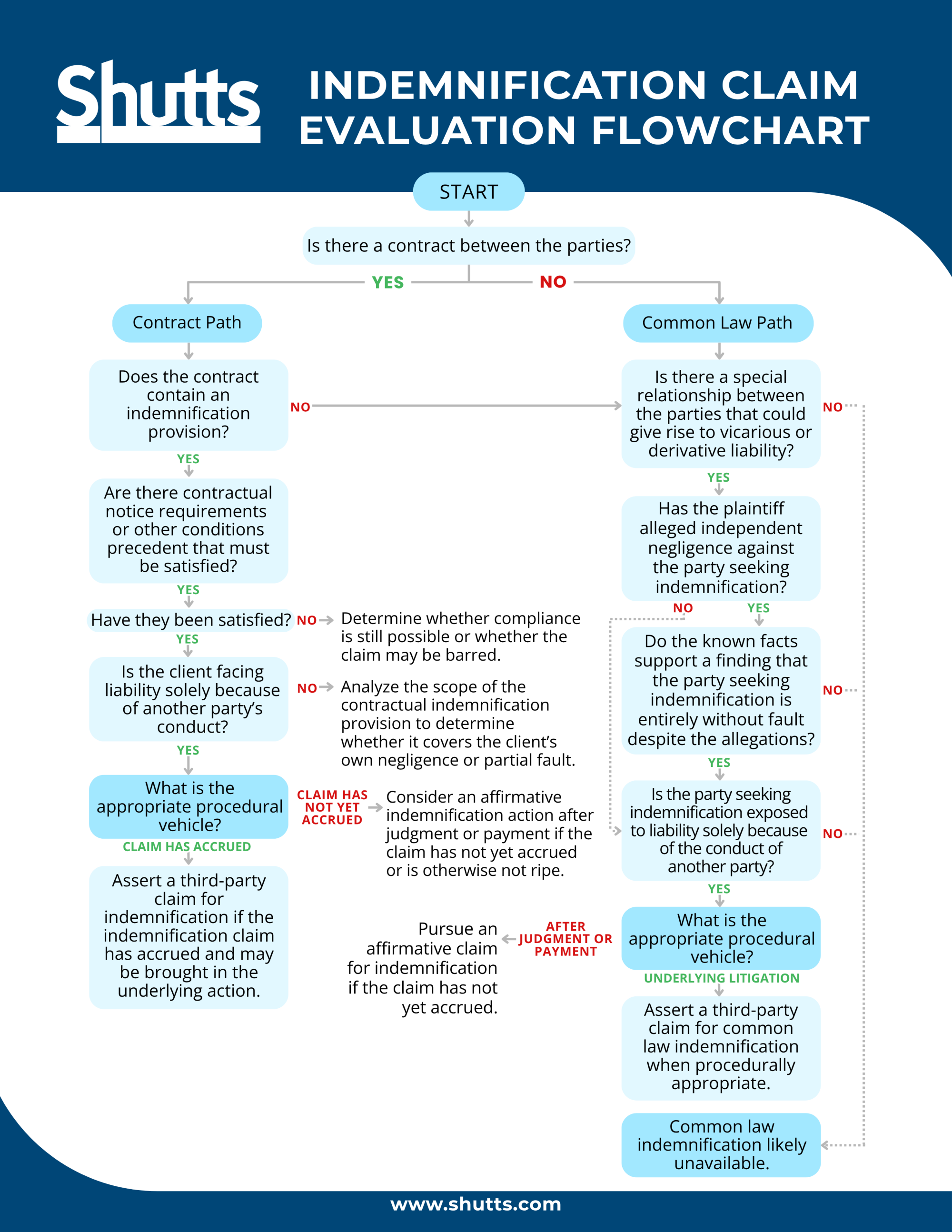
Download a printable version here: Indemnification Claim Evaluation Flowchart
Drafting Effective Indemnification Provisions
Because indemnification rights are often determined by contract language, careful drafting is essential. Practitioners should avoid using boilerplate indemnification provisions and consider tailoring them to the risks associated with the transaction.
When drafting or reviewing indemnification provisions, attorneys should clearly define the covered claims, losses, damages, and liabilities; address whether attorneys’ fees, costs, and expenses are recoverable; and establish notice requirements and procedures for tendering a claim. Thoughtful drafting at the outset of a transaction can significantly reduce the risk of future litigation over the scope and enforceability of an indemnity obligation.
Practical Considerations for Litigators
When evaluating a new case, practitioners should ask several key questions:
- Is there a contract?
- Does the contract contain an indemnification provision?
- Are there notice requirements that must be satisfied?
- Is the client facing liability solely because of another party’s conduct?
- Should a third-party claim, or crossclaim, for indemnification be asserted or should an affirmative claim for indemnification be pursued after a judgment is entered?
If no contractual indemnity provision exists, practitioners should not end the inquiry there. Instead, they should evaluate whether a viable claim for common law indemnity may exist and ask the following key questions:
- Is there a special relationship between the parties that could give rise to vicarious or derivative liability?
- Has the plaintiff alleged any independent negligence against the party?
- Do the known facts support a finding that the party is entirely without fault?
- Should a third-party claim for indemnification be asserted or should an affirmative claim for indemnification be pursued after a judgment is entered?
Asking these questions early in litigation can significantly impact strategy, exposure, and settlement leverage.
Conclusion
Indemnification is a powerful risk-shifting tool available to litigants. Whether arising under contract or common law, indemnity claims can alter the course of a case by shifting liability among the parties. Practitioners should identify potential indemnity rights early and carefully draft or review indemnification provisions. A carefully drafted indemnification provision can provide substantial protection when a dispute arises. In contrast, a poorly drafted provision can create uncertainty and expand the scope of litigation to include indemnification itself. Understanding both contractual and common law indemnification allows practitioners to better protect their clients, allocate risk, and effectively shift liability when circumstances warrant.
As part of their mentorship plan for the year, Eric and Melodie will be authoring 10 articles throughout the year on the 10 most impactful contractual provisions in commercial litigation. The blog post above serves as Article 3 in their 10-part blog post series.
 Partner
Eric S. Adams is a partner in the Tampa office of Shutts & Bowen LLP and Co‑Chair of the firm’s Business Litigation Practice Group. He previously served as Chair of the firm’s E‑Discovery Committee. With nearly 30 years of ...
 Senior Associate
Melodie Khosrovani is a Senior Associate in the Tampa office of Shutts & Bowen LLP, where she is a member of the Business Litigation Practice Group.
Melodie’s practice includes a broad range of litigation matters, including ...
Search Blog
Follow Us
Recent Posts
- Think Twice Before Pasting Your Lawyer's Document or Advice into AI and Other New AI Confidentiality Risks
- Jury Trial Waivers: What Florida Practitioners Should Know
- Assignment and Delegation Provisions: Who Can Enforce the Bargain?
- Before You Sign: 10 Things Student-Athletes Should Know About NIL Agent Agreements
- Florida’s New Contractor Discipline Law: What Every Licensed Contractor Needs to Know
- The Purpose and Importance of Indemnification Provisions
- Florida 2026 Noncompetition Update – Part 1: A Year Later, Florida's CHOICE Act Remains a Game Changer for Employers
- Filling the Gaps: Florida’s Infill Redevelopment Act
- Florida’s Expanded Flood Disclosure Requirements: Practical Considerations for Developers
- Representations, Warranties, and Warranty Disclaimers
Popular Categories
- Intellectual Property
- Business
- Contracts
- Employment and Labor
- Construction
- Construction Litigation
- Litigation
- Real Estate Law
- Business of Real Estate
- Landlord-Tenant
- Development/Land Use
- Florida Laws
- Jury Instructions
- Construction
- Florida Government Contracts
- Copyright
- Lease
- Government Contracting
- College Sports
- Education
- Protect College Sports Act
- Uniform Athlete Agents Act
- Appeals
- Litigation (Labor & Employment)
- Cybersecurity
- IP Litigation
- Patents
- State Government Contracts
- Supreme Court
- Flood Disclosure
- Trusts and Estates
- Warranties
- Competition
- Data Security
- Business
- Technology
- Regulatory Compliance
- Foreclosures
- Litigation (Appellate)
- Contracting
- Trademark
- Florida County Lands
- HUD-insured multifamily loans
- Privacy
- Estate planning
- Compliance
- Florida Public Contracts
- Government Contracts
- Financial Institutions
- DEI
- Government
- International Dispute Resolution
- Patent Office
- Wealth planning
- Federal Government Contracting
- Florida Bid Protests
- Public Contracts
- Department of Labor
- Insurance
- Infringement
- Commercial Leasing
- Conveyances
- Appellate Blog
- Public Private Partnership
- Bid Protest
- Proposal Writing
- Public Bidding
- Property Tax
- GAO
- Americans with Disabilities Act
- Health Care
- International
- Grant Writing
- Promissory Notes
- Florida Procurement
- Public procurement
- Arbitration
- Restrictive Covenants
- Liens and encumbrances
- Cyber fraud
- Title
- Small Business
- General Liability
- PTAB
- Technology
- Bidding
- International Arbitration and Litigation
- Salary
- Creditor's Rights
- Consumer Privacy
- International Arbitration
- Public Finance
- Venue
- Ad Valorem Assessments
- Attorneys' Fees
- Attorneys' Fees
- Florida Administrative Law
- Florida Rules of Appellate Procedure
- Inter Partes Review
- Consumer Protection
- Regulation
- Contracting
- Government Vendor
- Bankruptcy
- Florida Public Procurement
- Mortgages
- Liens
- FINRA
- Record on Appeal
- Rehearing
- Loan guaranties
- Power Generation
- Russia-Related Arbitration
- Statute of limitations
- Statute of repose
- Eviction
- Liens
- Damages
- Briefing
- Patents - Obviousness
- Request for Proposal
- Commercial Brokerage
- Trade Secrets
- Patents - Assignor Estoppel
- Dispute Resolution
- Maritime
- Bid Writing
- Florida Bidding Strategies
- Renewal
- Attorneys' Fees
- Florida Economic Incentive Packages
- Stay
- Certiorari
- Design Professionals
- email hacking
- Forum Selection
- Assignment of Contract
- Assignment of Proceeds
- Offers of Judgment
- Prevailing Party
- Settlements
- Banking
- Designer Liability
- Finality
- Fintech
- Lis Pendens
- Appellate Jurisdiction - Deadlines
- Evidence
- Evidence
- Expert
- Expert Science
- Federal Rules of Appellate Procedure
- Federal Supply Schedule
- Florida Public Records Law
- Marketing/Advertising
- Mootness
- Preservation
- Socio-Economic Programs
- Sunshine Law
- Unlicensed Contracting
- Veteran Owned Business
- Homestead
- Partnerships and LLCs
- Standing
Editors
- Partner
 Of Counsel
 Partner
 Partner
 Partner
 Partner
 Partner
 Partner
 Partner
 Associate
 Partner
 Partner
 Partner
 Senior Associate
 Partner
 Of Counsel
 Partner
 Associate
 Partner
 Senior Associate
 Partner
- Senior Associate
 Partner
 Partner
 Associate
 Partner
 Partner
 Partner
 Partner
 Partner
 Partner
 Partner
 Partner
 Partner
 Partner
 Partner
 Senior Associate
 Partner
 Partner
 Partner
 Of Counsel
 Senior Associate
 Partner
 Associate
 Partner
 Partner
 Partner
 Senior Associate
 Partner
 Associate
 Partner
Archives
- October 2026
- September 2026
- August 2026
- July 2026
- June 2026
- May 2026
- April 2026
- March 2026
- February 2026
- October 2025
- July 2025
- February 2025
- January 2025
- December 2024
- November 2024
- October 2024
- September 2024
- August 2024
- June 2024
- May 2024
- February 2024
- November 2023
- August 2023
- July 2023
- June 2023
- May 2023
- April 2023
- February 2023
- January 2023
- December 2022
- November 2022
- October 2022
- September 2022
- August 2022
- July 2022
- June 2022
- May 2022
- April 2022
- March 2022
- February 2022
- January 2022
- December 2021
- October 2021
- September 2021
- August 2021
- July 2021
- June 2021
- May 2021
- April 2021
- March 2021
- February 2021
- January 2021
- December 2020
- October 2020
- September 2020
- August 2020
- July 2020
- June 2020
- May 2020
- April 2020
- March 2020
- February 2020
- January 2020
- October 2019
- August 2019
- July 2019
- May 2019
- April 2019
- March 2019
- February 2019
- January 2019
- December 2018
- November 2018
- October 2018
- September 2018
- August 2018
- July 2018
- June 2018
- May 2018
- April 2018
- March 2018
- February 2018
- January 2018
- December 2017
- November 2017
- October 2017
- September 2017
- August 2017
- July 2017
- June 2017
- May 2017
- April 2017
- March 2017
- February 2017
- January 2017
- December 2016
- November 2016
- October 2016
- September 2016
- August 2016
- July 2016
- June 2016
- May 2016
- April 2016
- March 2016